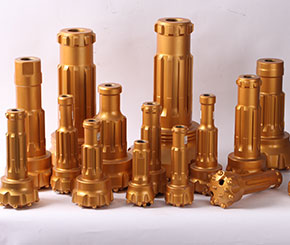
High-pressure air blast hole drill bit The down-the-hole drill bit is a type of drill bit used in conjunction with a down-the-hole hammer, which performs drilling operations through spline connections with the hammer. It is widely applied in open-pit mining, water well drilling, tunnels, quarries, hydropower projects, and other construction fields, featuring advantages such as deep and straight drilling, large borehole diameters, and high drilling efficiency. Depending on the working air pressure, it can be classified into high-pressure and low-pressure down-the-hole drill bits. The end face designs primarily include convex, flat, concave, and center-embedded types, with carbide inserts typically arranged in ball-shaped, spring-shaped, or a combination of both configurations. With technological advancements, continuous innovations have been made in materials, body performance, and tooth retention techniques. High-pressure down-the-hole drill bits consist of a drill rod and a drill bit tail pipe, with the drill bit tail pipe installed inside the inner hole of the drill rod. The tail pipe is composed of a skeleton and a damping body bonded onto the outer surface of the skeleton. These drill bits exhibit excellent resistance to high and low temperatures, impact, bending, tension, and fatigue, significantly extending their service life. [1] High-pressure down-the-hole drill bits are primarily used for blasting drilling and water well drilling projects, and are widely employed in mining, marble quarries, or drilling construction projects. basic characteristics The high-pressure air-rotary rock bit is a key component of the air-rotary rock drill, connected to the drill via splines for coordinated operation. It features straight drilling, high speed, high efficiency, and suitability for deep-hole drilling. Its fundamental characteristics primarily include type, structure, material, technical parameters, tooth arrangement and tooth profile design, as well as manufacturing processes. 1. Type The current end-face design forms of high-pressure hole-rock drills mainly include four types: convex end-face, flat end-face, concave end-face, and deep concave center end-face. The convex end-face drill maintains a high rock drilling rate when drilling moderately hard and hard abrasive rocks but exhibits poor hole straightness, making it unsuitable for rock drilling projects with high straightness requirements for blast holes. The flat end-face drill is relatively sturdy and durable, suitable for drilling hard and extremely hard rocks, as well as hard rocks with lower straightness requirements for blast holes. The concave end-face drill features a conical recess on the end-face, which helps maintain the drill's centering performance, ensuring better straightness of the blast hole and effective dust removal. The deep concave center end-face drill has a deep recess at the center of the end-face, ideal for drilling deep holes. By function, they can be categorized as general-purpose or specialized types; by diameter, they include small-diameter (300mm) drills. II. Structural Characteristics The high-pressure air-powered rock bit is connected to the air-powered rock drill (such as DHD series, CIR series, etc.) via splines for matching use and serves as the direct execution component for drilling operations with the air-powered rock drill. 3. Materials and Manufacturing Process The body of the drill bit is primarily made of imported high-grade steel (such as 40CrNi2MoV) to ensure overall strength and fracture resistance. The cutting teeth mainly utilize ultra-coarse grain cemented carbide, achieved through pressure sintering to balance high hardness and toughness. The process includes optimized tooth-setting techniques to enhance tooth retention, along with specific forging, normalization, quenching, and tempering heat treatments to improve the comprehensive mechanical properties of the drill bit body. IV. Key Technical Parameters The common specifications (diameters) for high-pressure hole drills range from 90mm to 305mm, including sizes such as 115mm, 127mm, 152mm, 165mm, 203mm, 254mm, and 304mm. For low-pressure hole drills, the typical size range is 76mm to 220mm. The accompanying high-pressure rock drills primarily include series like DHD340, DHD350, DHD360, DHD380, N125, and SD12. Low-pressure rock drills mainly feature the CIR series (e.g., CIR65, CIR90, CIR150, etc.). 5. Tooth Layout and Profile Selection Hard alloy teeth commonly adopt ball teeth, elastic teeth, or a combination of both. Tooth shape selection should be based on rock conditions (hardness, abrasiveness). Common tooth types include: ball teeth, suitable for highly abrasive and extremely hard rocks, often used as edge teeth; parabolic teeth, suitable for moderately abrasive and relatively hard rocks, commonly used as edge and middle teeth; bullet-shaped teeth, suitable for rocks with moderate abrasiveness and hardness, typically used as middle teeth; and pointed teeth, suitable for soft rock layers where high drilling speed and low tooth breakage rate are desired, often employed as middle teeth. The high-pressure rock bit features deep and straight drilling, large borehole diameter, high drilling efficiency, rapid excavation speed, multiple resharpening capabilities, and long service life. It is widely used in open-pit mining, quarrying, hydropower projects, well drilling, excavation and support of side columns, highway guard piles, building foundations, blasting drilling, and other applications. It is also extensively employed in large-scale rock excavation projects such as mining, well drilling, earthwork, foundation excavation, tunnels, quarries, and hydropower stations. In recent years, with the increasing mining depth of open-pit metal mines and the continuous rise in rock hardness, higher demands have been placed on the lifespan and reliability of drilling tools under hard rock conditions. The high-pressure air-rock drill bit has achieved enhanced fracture resistance and tooth retention capabilities through comprehensive upgrades in raw material selection, fundamental performance research of the bit body, tooth fixation process exploration, and simulation design. These improvements effectively address issues such as abnormal bit fractures and short lifespans in hard rock conditions. In practical applications, such as testing in various hard rock mines, the upgraded product has demonstrated extended service life. Additionally, the high-pressure air rock bit has a wide adaptability and can be used with down-the-hole hammers under various air pressure conditions, including low, medium, and high pressures. |
Previous: None
Next: What we can do



Copyright © Shandong Zhongrui Construction Co., Ltd. All Rights Reserved. Powered by